FOR UTILITIES
Built for the utilities solving LCRI in real time.
From small-system pilots to multi-thousand-parcel deployments — see how leading water utilities are using Service ID to turn LCRI compliance into a competitive advantage.
WHO IT'S FOR
Purpose-built for the utilities most affected by LCRI.
Service ID works across system sizes, regulatory environments, and inventory complexity — from small communities racing the LCRI clock to mid-sized utilities optimizing capital strategy across thousands of parcels.
Small Systems Racing the Clock
Utilities under 10,000 connections facing LCRI's November 2027 deadline with limited staff and constrained budgets. Service ID's homeowner verification model dramatically reduces the staff time needed to complete a defensible inventory.
Mid-Sized Utilities Scaling Up
Utilities serving 10,000–50,000 connections with complex inventories, multiple funding sources, and political accountability. Service ID provides the verified data and capital strategy your council, your engineers, and your regulators all need.
Forward-Looking Utilities
Utilities thinking beyond LCRI compliance toward asset management, institutional knowledge capture, and long-term decision intelligence. Service ID grows with you — every replacement, every funding decision, every field note compounds.
MULTI-STATE COVERAGE
Built for utilities across the Midwest and expanding.
Service ID's funding intelligence supports state-specific DWSRF programs — Wisconsin SDWLP, Illinois IFA Part 663, Indiana IFA, and more. Each state's DAC scoring methodology is built into the platform.
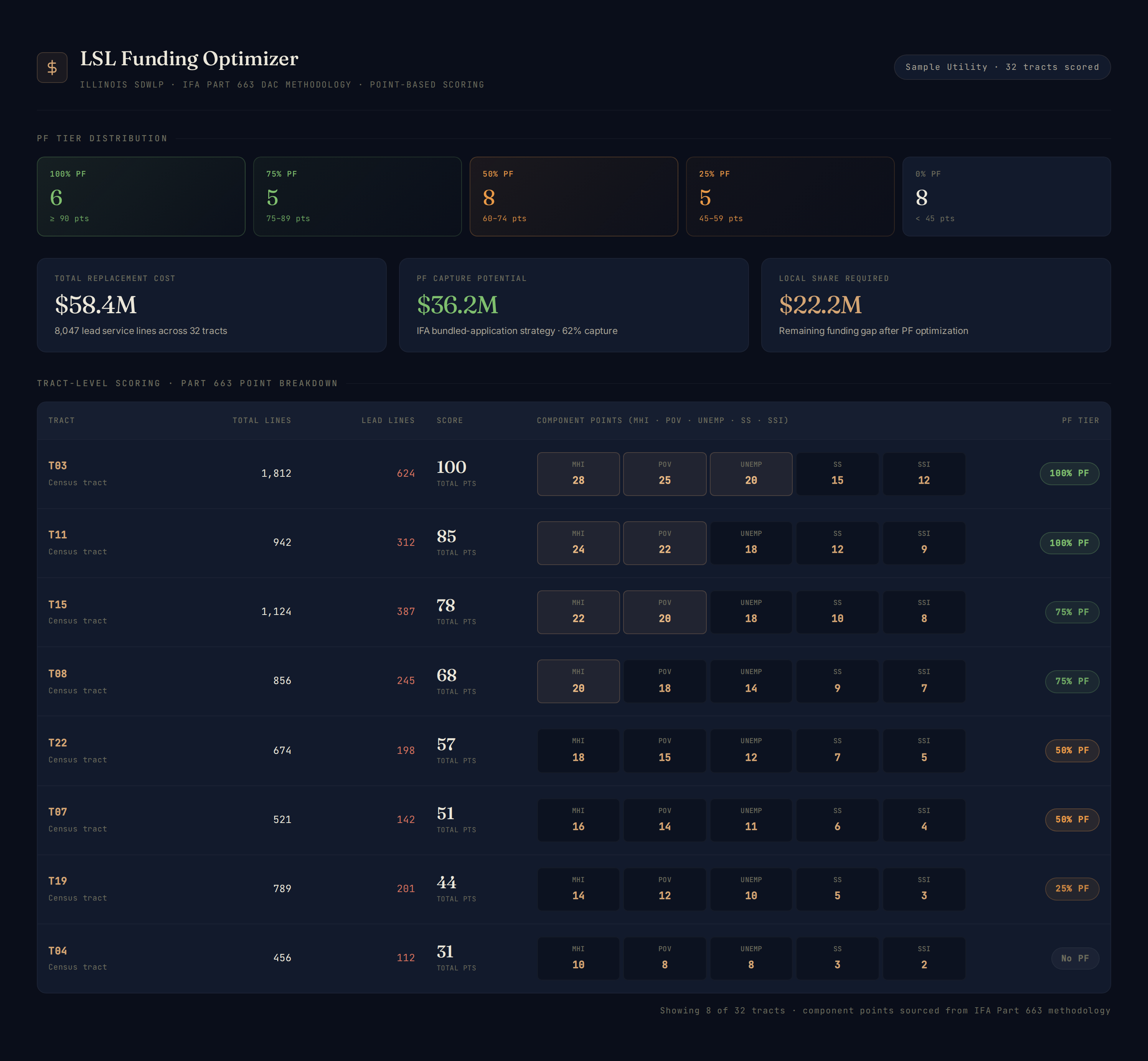
State-specific funding logic, unified platform.
Every state's principal forgiveness program scores disadvantaged communities differently. Wisconsin weights MHI as a percent of state. Illinois uses Part 663's point-based system across five components. Indiana, Michigan, and Ohio each have their own approach.
Service ID's Funding Intelligence layer applies the right methodology automatically — whichever state your utility is in. The output is the same: identify the tracts where your utility scores most competitively, structure bundled applications that maximize principal forgiveness, and show exactly which neighborhoods qualify for 100% PF before you invest staff time in the application.
- Wisconsin SDWLP — DNR Disadvantaged Community methodology
- Illinois IFA Part 663 — point-based scoring across 5 components
- Indiana, Michigan, Ohio — expanding coverage
FEATURED CASE STUDY
Verona Water Utility
How Verona verified their LSL inventory in under 30 days.
When Verona Water Utility partnered with Service ID to verify their LSL inventory, they were testing whether photo-based verification could scale. The results redefined what utilities should expect from a verification platform — homeowner participation rates dwarfed industry norms, classification accuracy held above 95%, and the full pilot completed in under a month for a fraction of projected cost.
Project Scope: 1,000 properties verified across Verona's oldest service area — neighborhoods with the highest concentration of legacy materials. Pilot completion: <30 days.
10–25×
INDUSTRY PARTICIPATION RATE
95%+
CLASSIFICATION ACCURACY
$125K+
IN PILOT SAVINGS
<30
DAYS TO COMPLETE PILOT
THE STORY
What Verona learned about photo-verified inventories.
The participation problem most utilities accept as inevitable.
The water industry's standard playbook for LSL inventories assumes 2–5% homeowner response rates. Utilities plan around that assumption — building budgets, staffing, and timelines for a process where most homeowners simply don't engage. Verona challenged that assumption.
How Verona reframed the homeowner conversation.
Service ID's outreach model treats homeowners as inventory partners, not data points. The 90-second photo workflow — accessible from any phone, requiring no app download — converted skeptics into contributors. The result: 10–25× the industry baseline participation rate, and a verified inventory built largely on customer-supplied evidence.
What it cost — and what it didn't.
Verona's pilot ran 80% below the cost of traditional staff inspections — and required less than 5 hours of total staff time across the entire engagement. Every property was photo-verified with human review, eliminating both the excavation costs and the staffing burden that typically dominate LCRI inventory budgets.
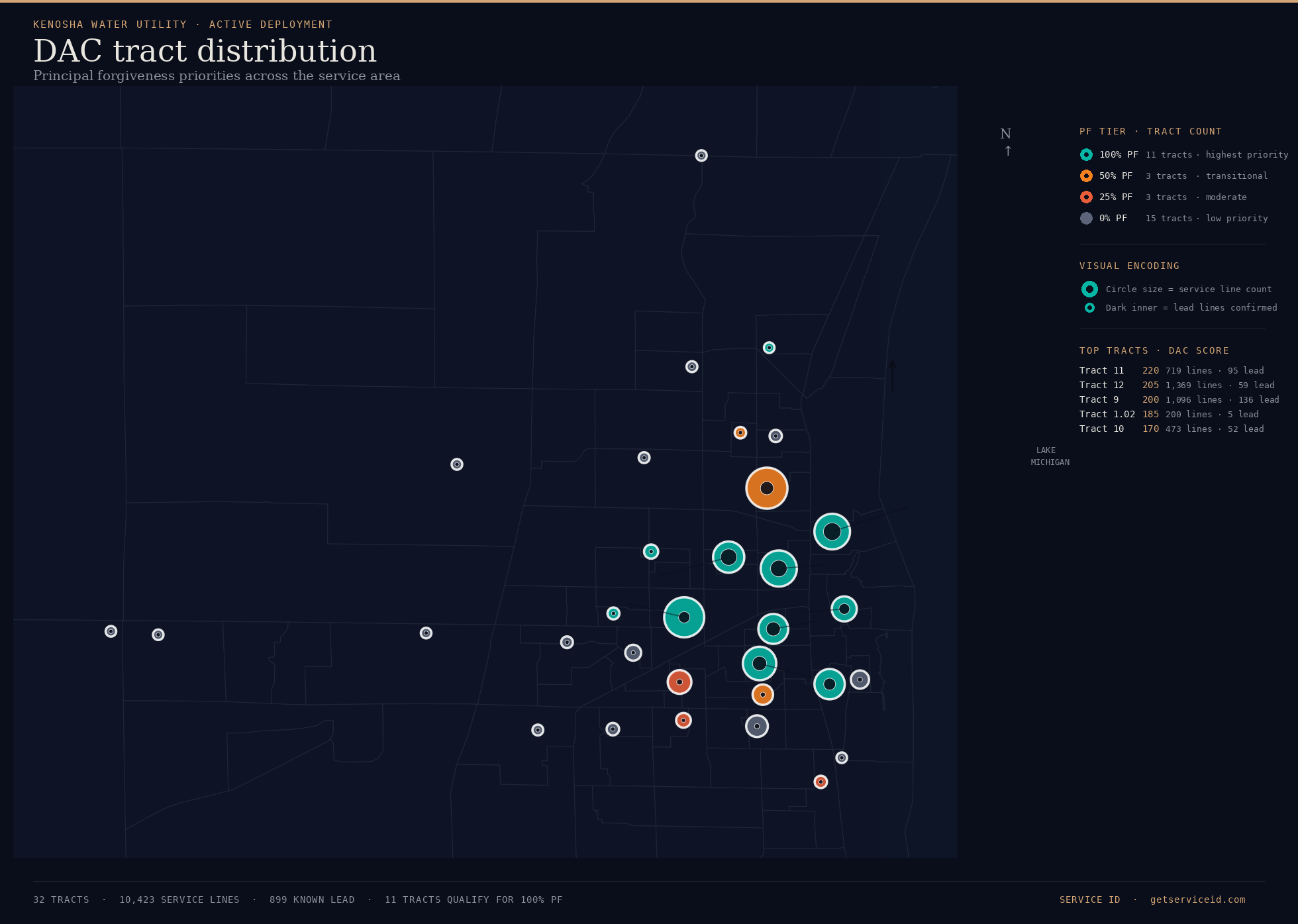
PRODUCTION DEPLOYMENT
Kenosha Water Utility
Service ID at production scale.
Kenosha Water Utility selected Service ID to verify service lines in the city's highest-DAC neighborhoods — over 3,200 parcels in the communities where homeowner engagement has historically been hardest, and where Principal Forgiveness eligibility is the most valuable. Where Verona proved the model, Kenosha is proving it where it matters most.
- 3,200+ parcels in active verification
- Targeted to the highest-DAC neighborhoods for maximum Principal Forgiveness eligibility
- Designed to reach the homeowners other engagement methods leave behind
WHAT TO EXPECT
From first conversation to verified inventory.
Service ID engagements follow a predictable arc — designed to move fast without sacrificing the regulatory rigor your inventory needs.
Discovery
We learn your inventory status, funding constraints, and LCRI timeline. You see Service ID running on real utility data.
Scoping
Joint scoping of parcel count, outreach approach, funding strategy, and integration with existing utility systems.
Launch
Branded homeowner outreach goes live. ML classification pipeline ingests submissions in real time. Utility dashboard activates.
Ongoing Intelligence
Verified inventory flows into funding eligibility, replacement planning, and the long-term institutional record. Service ID becomes your system of record.
READY TO START YOUR PILOT
The best way to understand what's possible is to see it running on your data.
Walk through Service ID with our team. Bring your unknowns, your funding questions, and your timeline. We'll show you how utilities like Verona and Kenosha got to verified.